Prevention
Website Care Plan Checklist: What’s Included and How It Helps SEO
A practical website care plan checklist — supervised updates, restore-tested backups, monitoring, security, and technical SEO hygiene — and how those operations help Google crawl and trust your site.
Josh
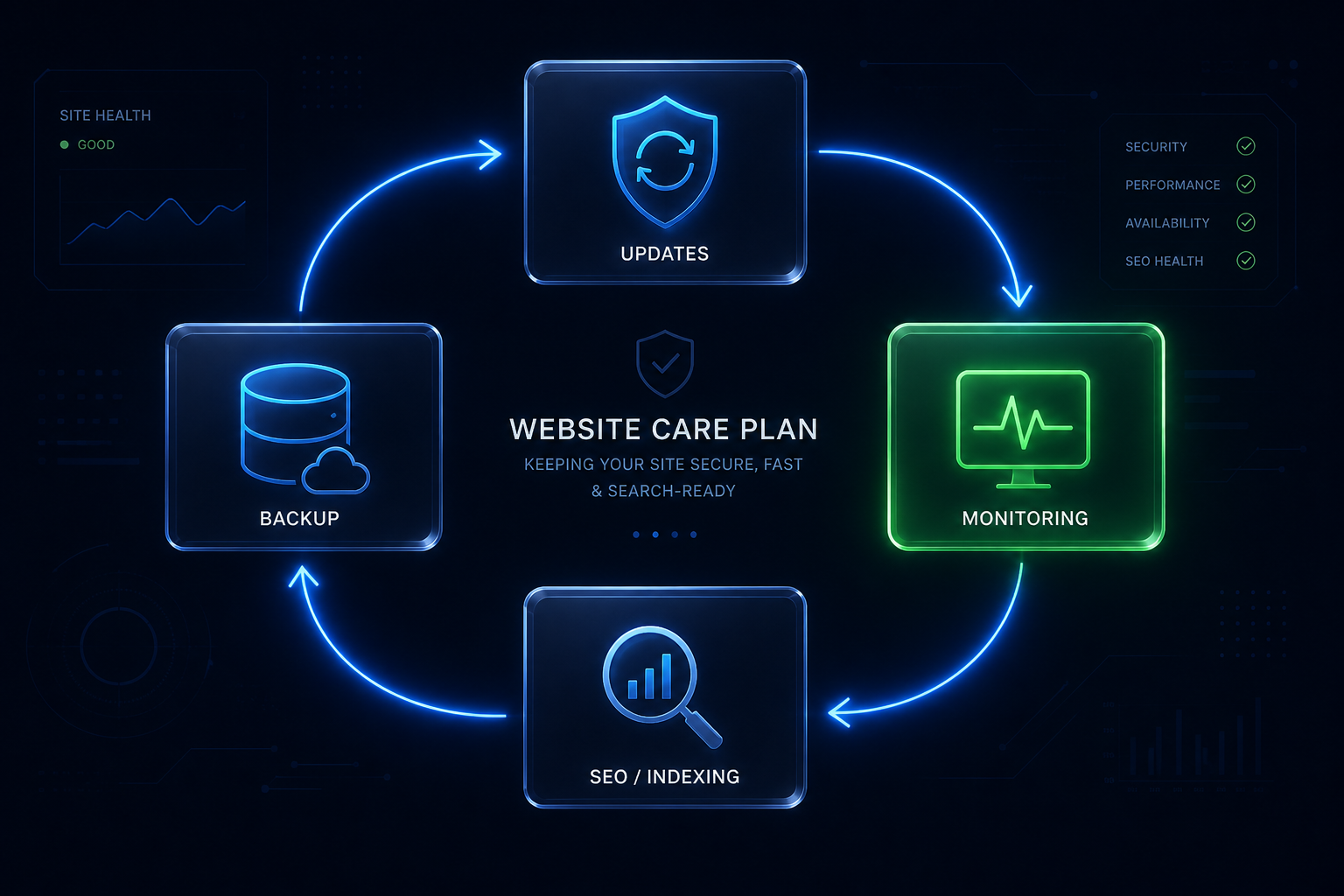
People searching for a website care plan checklist usually want two answers: what am I actually paying for each month, and does it help SEO? The short version: Care is operations. SEO benefits because Google cannot trust, crawl, or rank a site that is down, hacked, stuck after updates, or quietly blocking indexing.
This is not a promise of page-one rankings. It is the maintenance loop that keeps your technical foundation from rotting between marketing pushes.
What a real website care plan includes
Compare this to “someone clicks updates when they remember.” A serious plan covers the jobs that prevent revenue-killing surprises.
1. Supervised WordPress updates
Core, plugins, and themes change on their own schedule. Care means updates are reviewed, applied with awareness of conflicts, and watched afterward — not a blind “Update All” on a Friday afternoon. That alone prevents many of the breakages described in WordPress update broke my website.
2. Backups you can actually restore
Files existing in a folder is not protection. Care should include scheduled backups and restore verification so a bad deploy or host incident has a practiced recovery path.
3. Uptime, SSL, and failure monitoring
If the site or certificate fails, crawl frequency and user trust drop together. Monitoring that reaches a human beats discovering downtime from a customer screenshot.
4. Security and access hygiene
Malware, spam SEO injections, and mystery admin users destroy visibility faster than a weak meta description. Care watches for compromise symptoms and keeps access attributable — preferably with a dedicated operator account, not your personal owner login shared in email.
5. Performance and stack headroom
Slow TTFB, exhausted PHP memory, and plugin piles make pages harder to crawl and convert. Care is not a full redesign, but it keeps the environment operable: sensible limits, cache that does not break forms, and hosting that can actually be troubleshot.
6. Technical SEO hygiene tied to operations
Not “write 40 blog posts.” The Care-shaped SEO work looks like:
- Catching downtime and SSL errors that interrupt crawling
- Preventing update fallout that injects
noindexor breaks templates - Keeping sitemaps and critical pages reachable after migrations/restores
- Flagging Search Console emergencies (security issues, sudden coverage collapse) when access allows
- Reducing thin crawl traps created by broken filters or plugin URL spam
For deeper indexing triage, see how to fix crawled — currently not indexed and why a site may not show on Google.
Website care plan checklist (owner view)
Use this when comparing providers — including us:
- Named human responsibility and response expectations (time zone clear)
- Supervised core/plugin/theme updates with post-update checks
- Off-site or otherwise recoverable backups with restore testing
- Uptime and SSL monitoring that alerts a person
- Security awareness / malware response path
- Staging or safe change path when the stack allows it
- Documented access (WP admin, hosting, DNS) not trapped in one personal inbox
- Clear boundary: what support tickets Care covers vs billable projects
- Honest SEO scope: technical foundation yes; ranking guarantees no
- Hosting reality: eligible plans operable on managed hosting, not locked shared boxes
If a quote only says “unlimited updates + monthly report,” ask what happens the night an update whitescreens the site.
How Care helps SEO without pretending to be an SEO agency
Google rewards sites it can fetch, understand, and trust over time. Care supports that by:
- Keeping the site up so crawlers and customers are not hitting errors
- Preventing self-inflicted indexing damage from sloppy updates and plugin collisions
- Recovering faster after incidents so rankings do not decay during multi-day outages
- Reducing malware spam that can trigger Safe Browsing or thin spam signals
- Preserving clean technical signals (HTTPS, reachable money pages, working templates)
Content strategy, local citation campaigns, and competitive link work still matter. They work better on a site that is not constantly broken.
Care vs repair vs redesign
| Situation | Right move |
|---|---|
| Site down or critically broken now | Emergency / website repair |
| Site stable, needs ongoing ops | Website Care Plan |
| Business needs new look/IA/content | Redesign (after the fire is out) |
You do not need Care to hire a repair. Care is how you stop paying for the same emergency twice.
Takeaway
A website care plan is a checklist of operations: supervised updates, restore-tested backups, monitoring, security, and technical hygiene. Those jobs help SEO because they keep your site crawlable, indexable, and trustworthy. They do not replace content or competition — they keep the foundation from failing underneath them.
If you want that loop run on eligible WordPress or WooCommerce sites with managed hosting included, start with Website Care Plans. If the site is already damaged, repair first — then enroll.
Frequently asked questions
Does a website care plan guarantee higher Google rankings? +
How is a care plan different from clicking Update Plugins? +
What SEO tasks are usually included vs separate? +
Do I need Care if my site is already broken? +
Why does managed hosting matter for SEO care? +
Related in Prevention
-
Prevention
How to Fix “Crawled — Currently Not Indexed” in Google Search Console
Step-by-step triage for Google Search Console’s “Crawled — currently not indexed” status — what it means, which pages to ignore, and how to fix money pages that Google crawls but will not index.
-
Prevention
Why Is My Website Not Showing Up on Google? Causes and Fixes
Diagnose why your website is missing from Google — indexing problems, DNS/hosting outages, noindex mistakes, thin pages, and ranking vs visibility — with a clear fix order and when to get repair help.
-
Prevention
Namecheap outage lesson for Jamestown NY — why you need a website care plan
The August 2026 Namecheap outage showed why Jamestown, Buffalo, and Great Lakes businesses need a website care plan, managed hosting, off-site backups, and fast DNS failover.